· · · · · · · · · · · · · · · · · · · · · · · · · · · · · · · · · · · · · · · ·
Blake3 Hashing
Blake3 Deep Dive
Astral uses Blake3 as its cryptographic hash function. This document explores why we chose Blake3 and how it's integrated into Astral's architecture.
Why Blake3?
Hashing speed on modern hardware (AVX2), compared to ~2 GB/s for SHA-256.
Security level. Provides the same security margin as SHA-256.
Key Properties
- Speed: Blake3 is designed from the ground up for performance on modern CPUs
- Parallelism: The Merkle tree structure enables multi-core hashing
- Security: Based on the well-analyzed Blake2 and ChaCha primitives
- Versatility: Can be used as a hash, MAC, KDF, and PRF
The Merkle Tree Structure
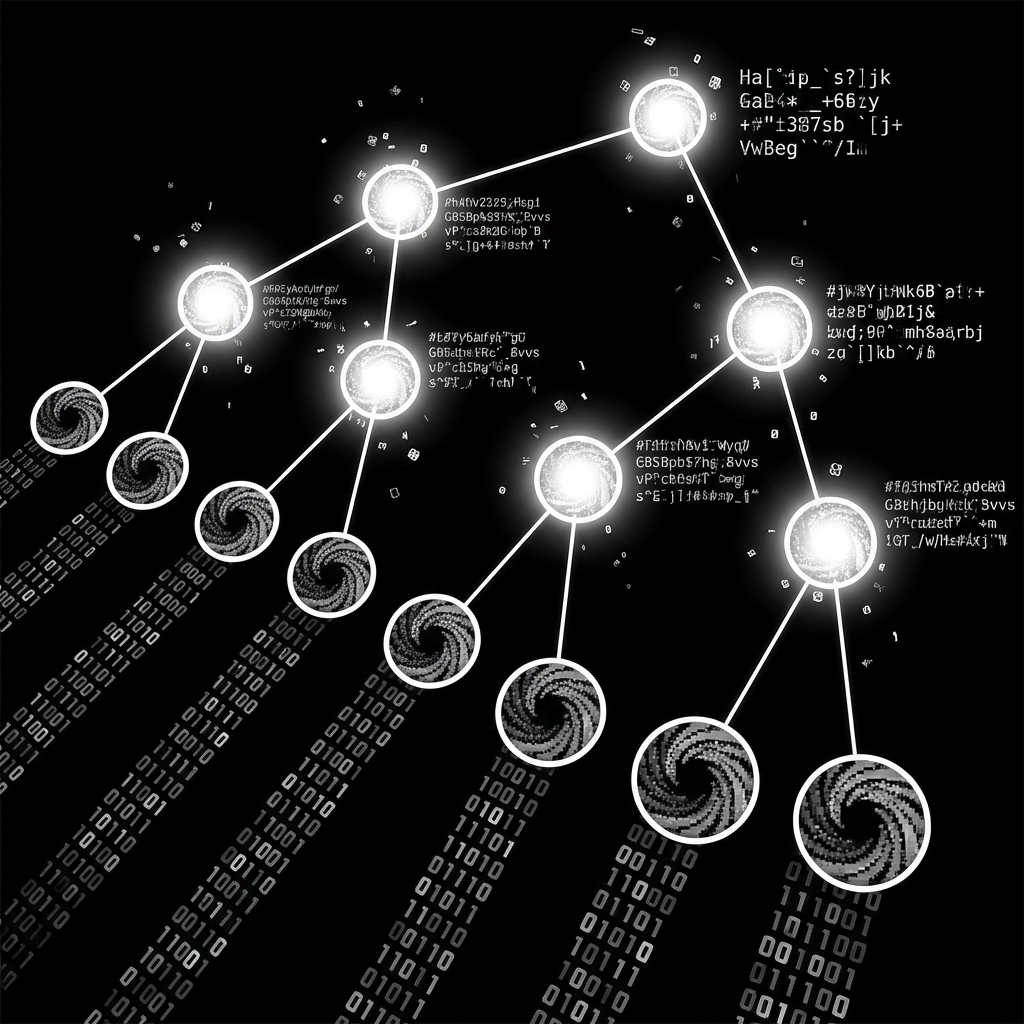
Unlike traditional hash functions that process data sequentially, Blake3 uses a Merkle tree internally:
Each chunk (1 KB) can be hashed independently
Benefits for Astral
- Parallel hashing: Large files can be hashed across multiple cores
- Incremental updates: Only changed chunks need rehashing
- Streaming: No need to buffer the entire file in memory
- Verified streaming: Can verify chunks as they arrive
Benchmarks
Performance comparison on AMD Ryzen 9 (16 cores):
Implementation
Astral uses the official Blake3 Go implementation:
import "github.com/zeebo/blake3"

func HashObject(content []byte) [32]byte {
    return blake3.Sum256(content)
}

// For large files, use streaming:
func HashFile(path string) ([32]byte, error) {
    f, err := os.Open(path)
    if err != nil {
        return [32]byte{}, err
    }
    defer f.Close()

    h := blake3.New()
    if _, err := io.Copy(h, f); err != nil {
        return [32]byte{}, err
    }

    var hash [32]byte
    h.Sum(hash[:0])
    return hash, nil
}
SIMD Optimization
The implementation automatically uses:
- AVX-512 on supported Intel/AMD processors
- AVX2 on most modern x86-64 CPUs
- NEON on ARM64 (Apple Silicon, AWS Graviton)
- Pure Go fallback for other architectures
Security Considerations
Blake3's security properties:
| Property | Status | | :--- | :--- | | Collision Resistance | 128-bit (birthday bound) | | Preimage Resistance | 256-bit | | Second Preimage Resistance | 256-bit | | Length Extension | Immune (due to tree construction) |
While Blake3 is newer than SHA-256, its core compression function is derived from Blake2 (analyzed since 2012) and ChaCha (analyzed since 2008), both with extensive cryptographic review.